Documentation drift
READMEs, wikis, worker dashboards, deployment notes, and setup instructions move apart until nobody knows which file is the truth.
Source Atlas turns scattered READMEs, worker dashboards, ADRs, health endpoints, task lists, settings, and agent instructions into one live operational layer — readable by humans, queryable by MCP, and built for teams shipping with Claude Code, Codex, Cursor, and Copilot.
Source Atlas gives the crowd using Claude Code, Codex, Cursor, and other coding agents something they badly need: a visible place where project rules, platform standards, documentation, and fleet health come together.
The animation explains the product in one glance. A simple CLAUDE.md file is pulled from the terminal, absorbed into Source Atlas, structured into rules, and then expanded into live monitoring and full documentation.
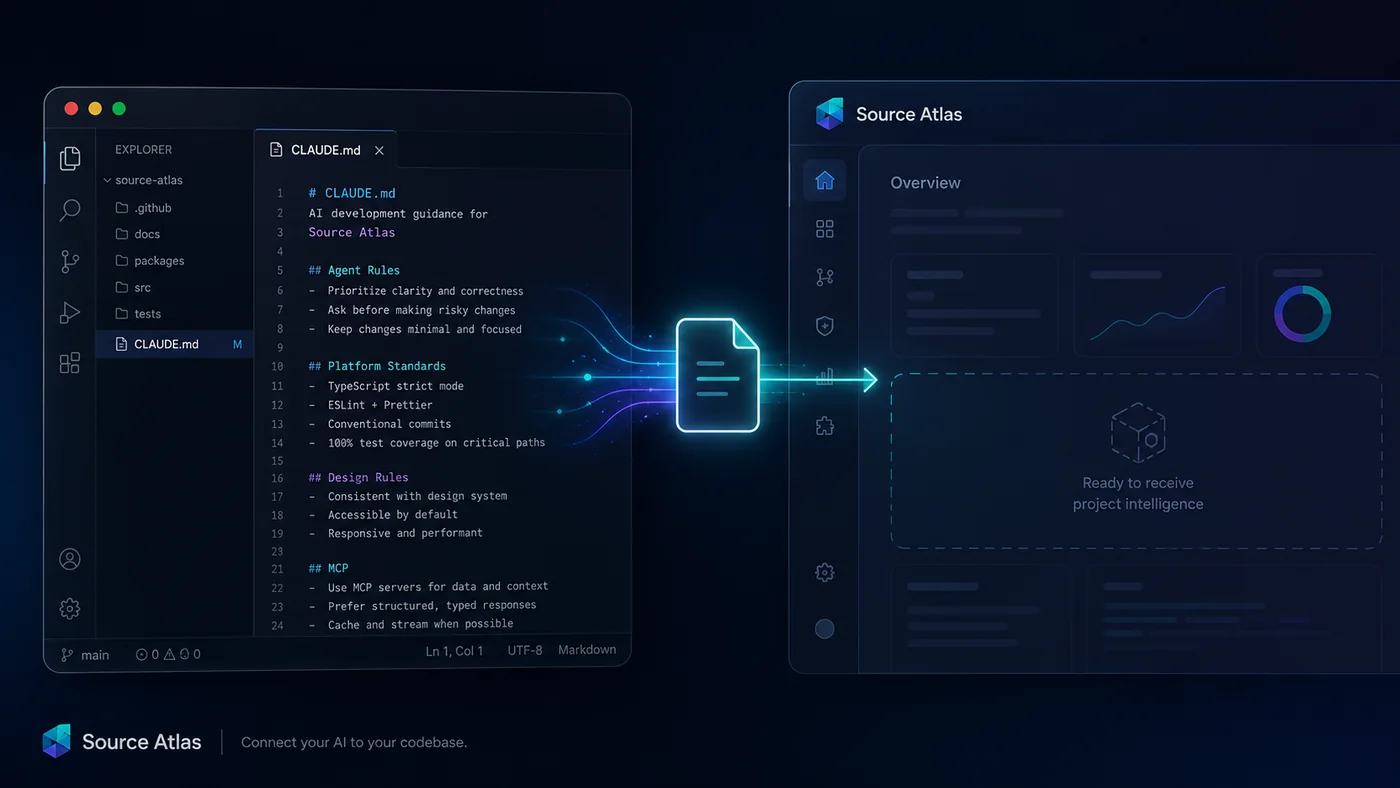
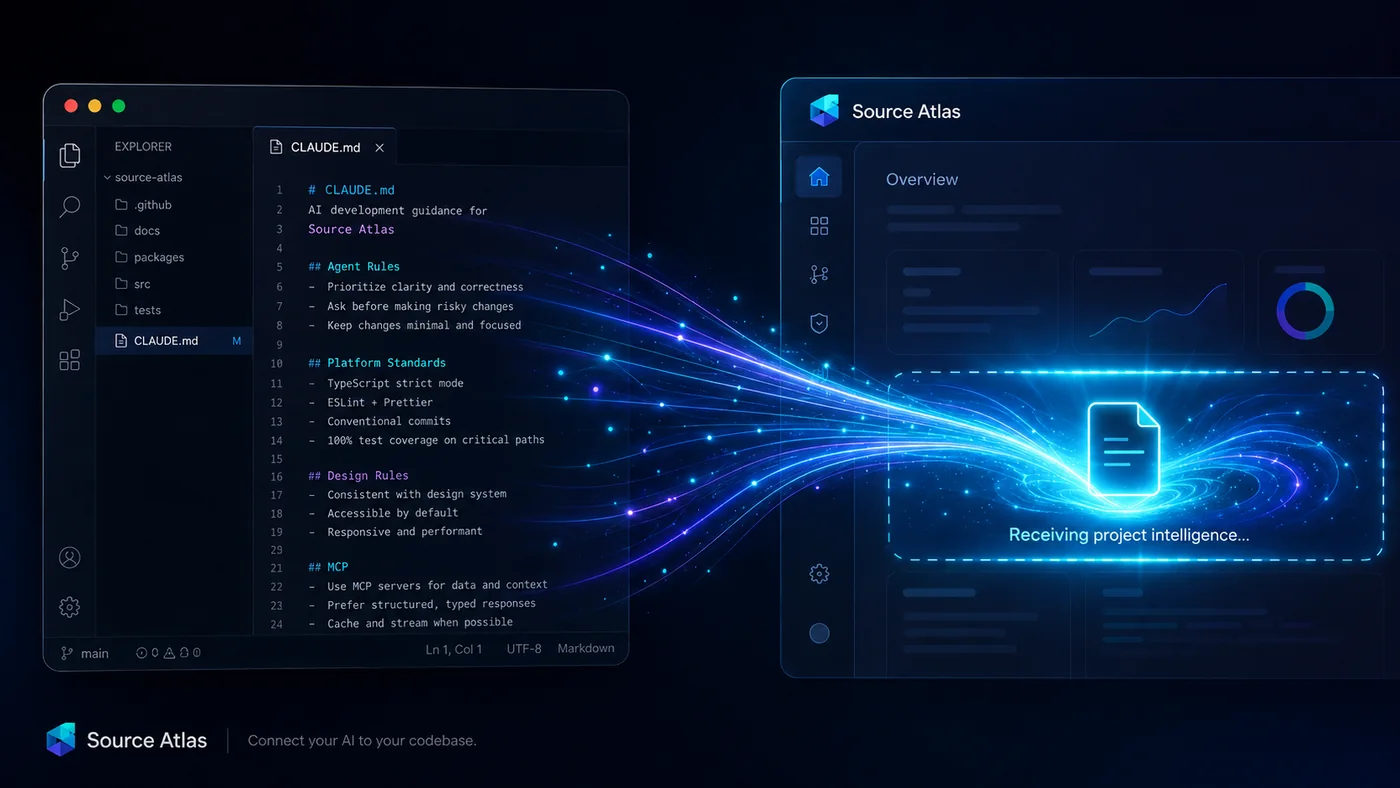
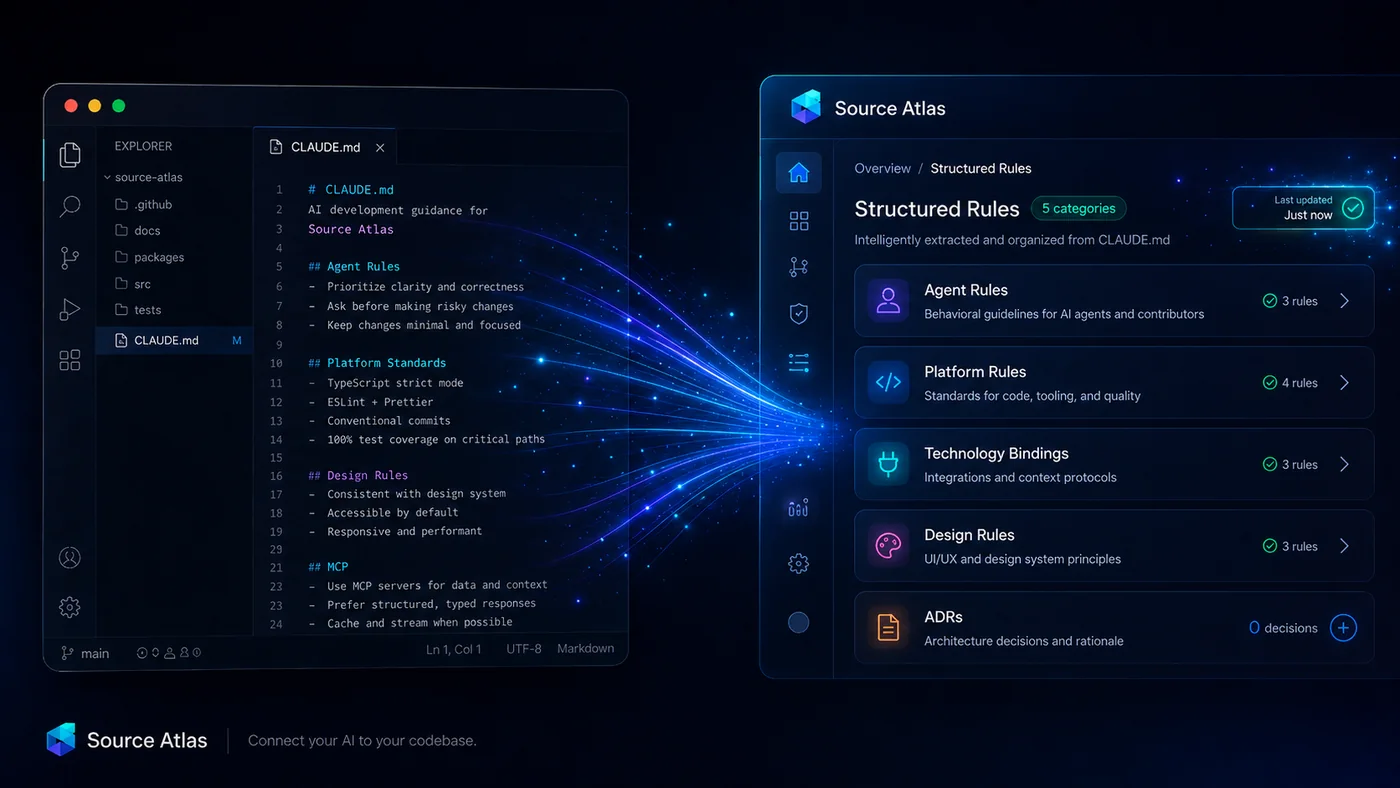
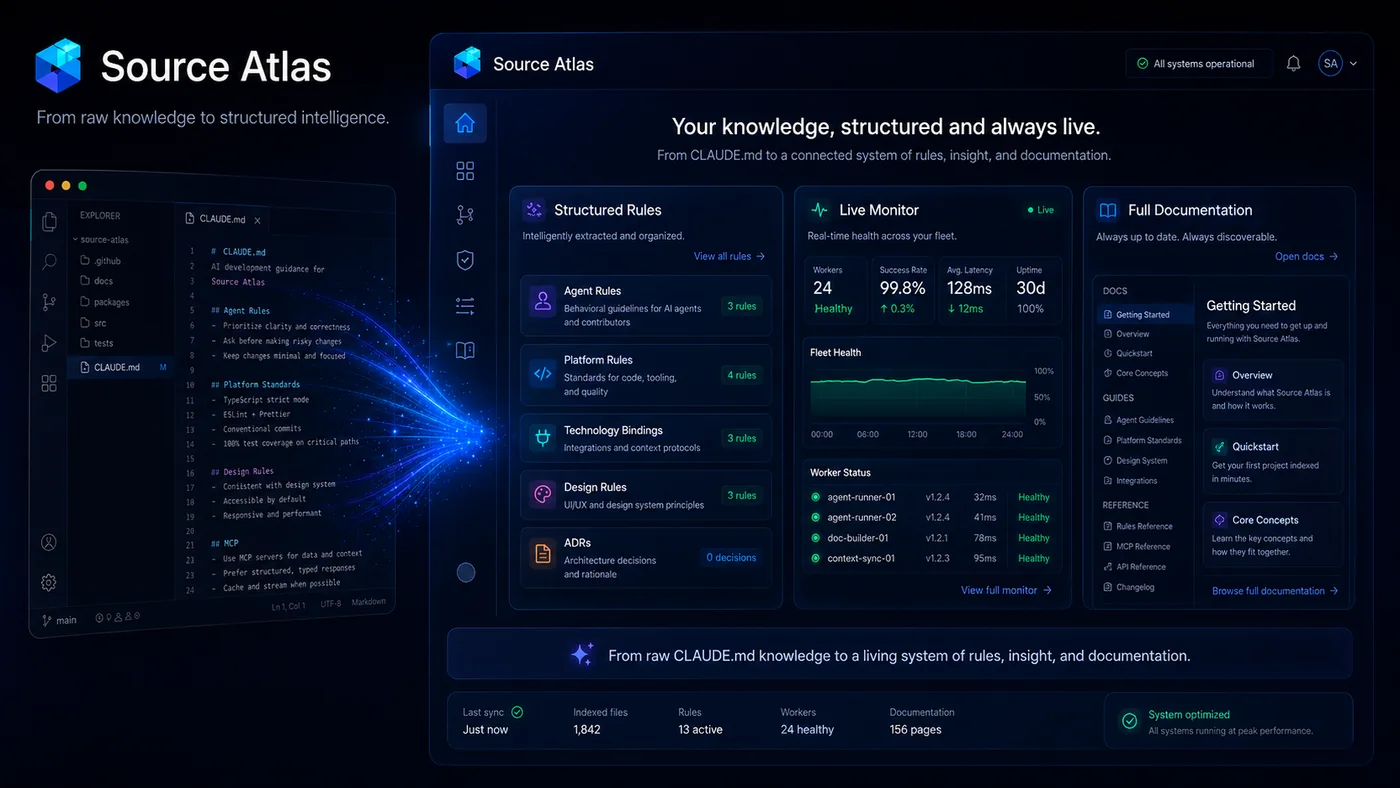
CLAUDE.md, platform rules, and project guidance stop hiding inside repos and become visible product intelligence.
Agentic development creates a new operating problem: every repo has rules, every worker has settings, every product has runbooks, and every AI session starts by guessing what the platform already knows.
READMEs, wikis, worker dashboards, deployment notes, and setup instructions move apart until nobody knows which file is the truth.
Claude Code, Codex, Cursor, and Copilot can move fast, but they repeatedly rediscover architecture decisions that should already be available.
Management needs readiness, risk, health, and progress across many workers — not another loose bundle of technical notes.
Workers register docs, manifests, health endpoints, source-linked rules, status pages, and computed feature matrices. Source Atlas turns them into one searchable, governed, agent-readable operational view.
No heavy developer portal. No forced framework. Every worker stays free to be itself, while the hub reflects truth from source and published health.
Each worker publishes its manifest, docs, health endpoint, dashboards, and result pages through one API call.
Source Atlas renders documentation live from GitHub, grouped by product, worker, environment, and domain.
The hub probes registered workers and builds a fleet-level view of health, latency, phase, and feature completeness.
Human operators read the site. AI agents query the same context through MCP before changing code.
The product speaks to the people building with AI and the people accountable for delivery, uptime, onboarding, and governance.
Open one source-of-truth URL or connect MCP before the agent edits code. Less prompting, fewer wrong assumptions.
Keep platform rules, ADRs, worker settings, manifests, and runbooks visible across every repo and environment.
See live worker health, latency, status, feature completeness, and deployment readiness from one screen.
Translate technical progress into a clear view of what exists, what is live, and what needs attention.
Start free for public proof. Upgrade when the team needs private docs, MCP, RBAC, custom domains, auditability, and serious fleet visibility.
For individual builders proving the pattern.
For small AI-assisted teams shipping real products.
For multi-worker platforms and internal toolchains.
For agencies, enterprise teams, and isolated deployments.
Source Atlas is positioned as its own product brand: commercially framed by CIOatWork for management trust, engineered by Mondial-IT for technical proof, and ready to document the wider product ecosystem: Account Revenue, GPN Places, directory products, relocation canvases, and every new Worker shipped by the team.
Connect your Worker fleet, publish source-linked context, and give developers, agents, operators, and management one reliable operating map.